There is a well-known, long-running Harvard study on adult happiness that keeps coming back to the same conclusion: what matters most in life is feeling connected and useful to others. Not achievements. Not status. Contribution and relationships.
That idea lines up nicely with a large, peer-reviewed study published in The BMJ, where researchers followed people over many years and found that happiness is not something we experience alone. It spreads through relationships. When people around us feel happier, we are more likely to feel happier too. Happiness is social. It grows in groups, families, and everyday interactions.
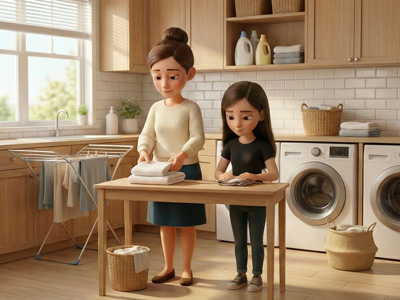
When kids help out at home, even in small ways, they are not just “doing tasks”. They are participating. They are contributing to the family system. They experience that their actions matter to others, and that feeling tends to come back as pride, confidence, and yes, happiness.
This does not mean kids need more pressure or responsibility than they can handle. It simply means that being part of the shared effort, rather than watching from the sidelines, can be surprisingly meaningful for them.
At Tasks ’n Chores, we are not researchers or experts. We just keep seeing the same pattern in real families: kids often feel better when they feel needed. Structure helps. Clarity helps. And contribution, done in a supportive way, often helps everyone feel a little more like a team.
If you want to read the research behind the idea that happiness spreads through relationships, you can find the BMJ study here.
While the BMJ study looks at happiness through relationships more broadly, research on children and development often points in a similar direction when it comes to contribution at home.
Across multiple long-term and observational studies, a few patterns show up again and again:
Kids who help at home often develop a stronger sense of responsibility
Not because they are forced to, but because they experience being trusted. Small, age-appropriate chores signal: “You are capable.” That feeling tends to stick.
Contribution supports independence and confidence
Doing things for the household builds practical life skills, but it also builds something less visible: confidence in one’s own ability to handle everyday life. That confidence is closely tied to well-being.
Shared responsibility strengthens family bonds
When chores are framed as “this is how we help each other” rather than “this is your job”, they become part of the family culture. Kids who feel like part of a team often feel more connected and secure.
Meaning matters more than rewards
Many studies suggest that while rewards can work short term, the long-term benefits come from feeling useful and included. Contribution itself becomes motivating when kids understand why it matters.
None of this means there is one right way to do things. Families work differently. Kids are different. But the overall picture is fairly consistent: children tend to thrive when they feel they belong and contribute in ways that make sense for their age.
That is the part we find most interesting. Not chores as discipline. Not chores as transactions. But chores as a simple, everyday way for kids to feel involved in something bigger than themselves.
Tasks ’n Chores was not built to make kids work more. It was built to make contribution clearer, calmer, and more fair for everyone involved.
Many families already believe in kids helping out. What often breaks down is consistency, expectations, and mental load. Who was supposed to do what? Was it done? Does it always fall back on the same parent to remember?
A shared system helps with that.
By giving the family a common place to agree on chores, timing, and goals, Tasks ’n Chores supports the idea of contribution without turning it into pressure or constant reminders. Some families use points, some use stars, some use no rewards at all. The structure is flexible, because families are different.
What matters to us is not the model, but the feeling behind it: that kids are part of the household, not just living in it.
If a tool can help reduce friction, make expectations clearer, and support that sense of teamwork, then it has done its job.
And if an app is not the right fit for your family, that is perfectly okay too.
The goal is not perfect systems.
It is raising kids who feel capable, included, and connected.