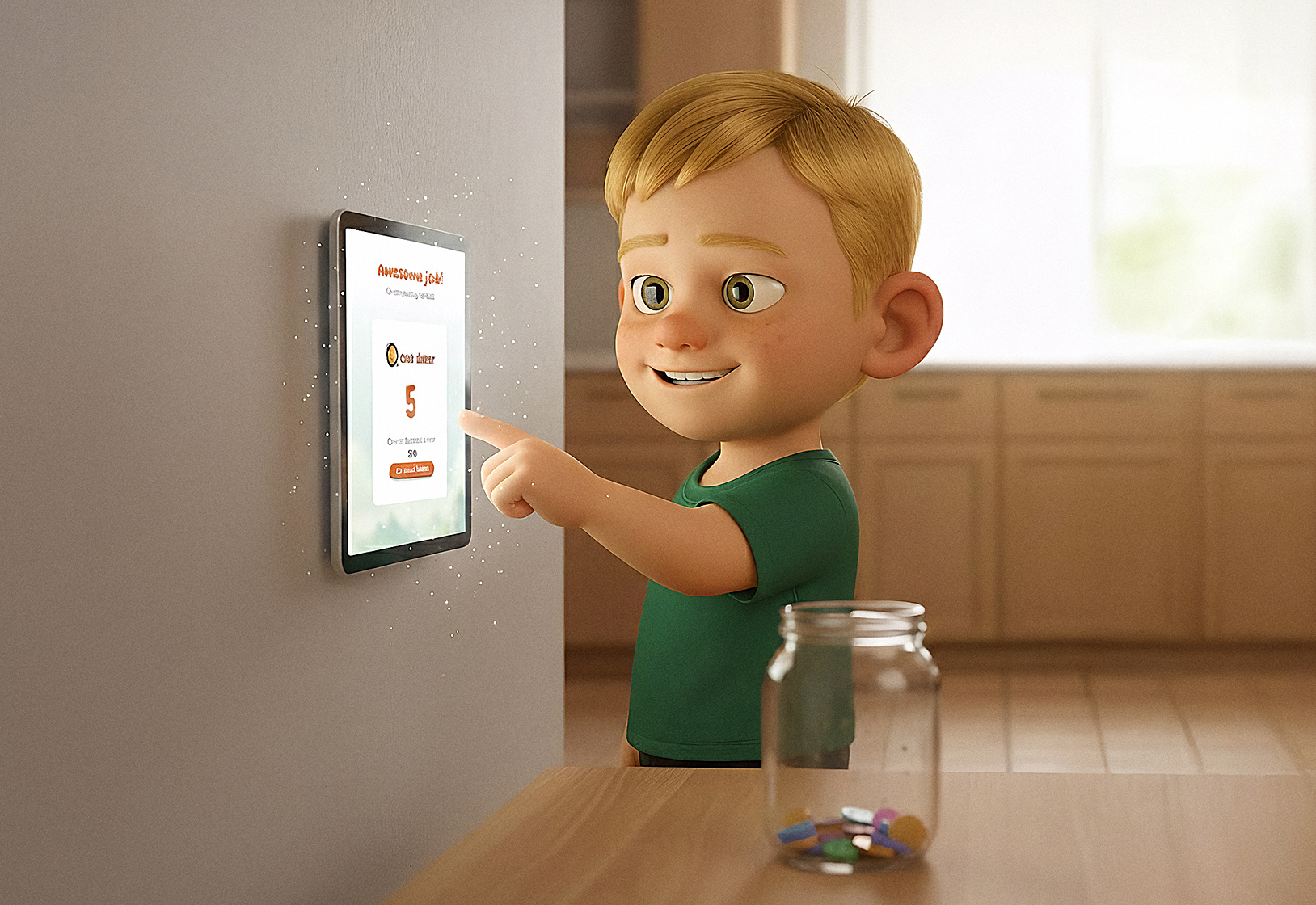
If you have kids in the UK, you have probably seen some version of “the token jar” everywhere: at home, in classrooms, in after-school clubs. Sometimes it is literally a jar with marbles. Sometimes it is poker chips in a cup. Sometimes it is “house points” with little plastic tokens that children drop into their team’s tube.
Different packaging, same engine: a token economy.
And that is important, because the token jar is not just a cute parenting hack. It is a behavior science tool with decades of research behind it, and it is used in schools precisely because it is simple, visible, and motivating.
What follows is a deep dive into what the token jar really is, why it is so effective, what pitfalls to avoid, and how Tasks ’n Chores can act as a digital replacement that keeps the magic while removing the daily friction.
A token jar is a practical, kid-friendly version of a token economy: you reward desired behavior with a small token (a marble, sticker, coin, point), then later the child exchanges tokens for a bigger reward.
In UK schools, this often shows up as house point systems, classroom “reward jars”, or physical tokens that students collect and deposit into a class or team container.
That physical “drop the token in” moment matters. It turns something abstract (“good job”) into something concrete (“I can see my progress”).
1) It makes rewards immediate even when the real reward is later
Kids often struggle to stay motivated when the payoff is far away. Token systems solve that by giving a small, immediate win (the token) while the big reward comes later.
2) Tokens become motivating on their own
Over time, tokens can act as “conditioned reinforcers”. In normal human terms: the token itself starts feeling good because it reliably predicts something good.
3) Research generally finds token economies can improve classroom behavior
There are systematic reviews showing token economies can increase appropriate behavior for students with behavioral difficulties, and there are reviews and meta-analyses in K–5 settings reporting positive effects overall.
4) It is flexible: individual, sibling, or whole-class
You can run a token jar for one child, multiple children, or a whole class working toward a shared goal. That is one reason “marble jar” style systems are so popular.
Even good systems break when real life hits. Common failure points show up again and again in guidance on token economies:
The biggest practical issue for families is simpler: admin overhead.
You need the jar, the tokens, the reward menu, the tracking, and the constant mental load of remembering to do it. In a busy home, that is exactly what disappears first.
Parents often think the jar is “a reward”. But the real reason it changes behavior is that it becomes a tiny feedback loop:
The jar is not magic. The loop is.
So if you want a digital replacement, it must preserve the loop, not just replace plastic tokens with numbers.
A good digital token jar should do four jobs at once:
Make expectations clear
Chores and routines are defined in plain language, so kids know exactly what earns progress.
Make progress visible all the time
Instead of a jar on a shelf, progress lives where your family already looks: on a phone or tablet. Digital visibility can also reduce arguments because the system is the “source of truth”.
Make reinforcement consistent even when parents are tired
Consistency is the hardest part of token jars. A digital system can help by making completion easy to log, keeping the rules stable, and nudging parents and kids with reminders.
Make rewards structured, fair, and less negotiable
Token jars often break down into constant negotiation: “Can I have it now?” A digital setup can support a clear exchange rate (tokens earned versus rewards unlocked) and keep the reward menu consistent.
Under the hood, you are still using the same evidence-based mechanism: a token economy. You are just removing the physical friction that causes families to abandon it.
A digital token jar only works if it mirrors the simplicity of the systems used in homes, while still fitting the reality of family life. Tasks ’n Chores is built around that same logic, just without the physical jar and constant manual tracking.
The easiest way to start is to keep the focus narrow and time bound. Choose three to five clear, observable behaviors and commit to them for a short period, typically around two weeks. This might be completing the morning routine, starting homework without arguing, emptying the dishwasher, putting clothes in the laundry basket, or sticking to the bedtime routine. Token systems work best when there is no ambiguity about what earns progress.
Once the behaviors are defined, decide how progress is rewarded. In Tasks ’n Chores, every completed task adds value either to the child’s personal balance or to the family goal balance. These two goal types cannot run at the same time, which keeps expectations clear. A task is either for the child or for the family, never both.
Some families keep it simple and assign a fixed amount for each completed task. Others add occasional bonuses for effort that goes beyond expectations, like helping a sibling or finishing without reminders. The key is consistency rather than complexity.
Rewards are where the digital token jar really replaces the physical one. Instead of a single distant prize, it helps to think in levels. Small rewards might be choosing music in the car or earning extra screen time. Medium rewards could be picking dessert or deciding on a family activity. Larger rewards might be a cinema trip, a new book or game, or a sleepover with a friend.
Tasks ’n Chores supports whatever “currency” your family agrees on. That currency is account wide rather than individual. It can represent real money, screen time, points, stars, or something entirely your own. A family goal like a trip to the movies can live alongside individual saving, as long as it is clear which tasks contribute to which balance. Points or stars can later be cashed in for agreed rewards, or simply tracked as progress. In practice, most families find that rewards tied to real outcomes are more motivating than keeping score alone.
One important element often overlooked is the plan for fading the system. As behaviors become routine, the emphasis should slowly shift. Tokens can be reduced, rewards spaced out, or replaced with more natural privileges linked to responsibility and independence. This is how schools prevent token systems from becoming permanent crutches, and the same principle applies at home.
Physical token jars tend to break down in families with more than one child. One child may feel the system is unfair, another may dominate the rewards, and parents quickly lose track of who earned what.
A digital setup avoids most of this friction. Each child’s progress is visible and separate, while family goals remain shared. Everyone can work toward something together, like a pizza night after five smooth evening routines in a row, without blurring individual effort.
That combination of personal responsibility and shared wins is one of the reasons token systems have worked so well in classrooms for decades, and why they translate so naturally into a well designed digital version.
Let’s address the worry many parents have: “Will this make my child only help when there is a reward?”
The goal of a token jar is not permanent bribery. It is training wheels.
Token economies are often discussed as a way to build behaviors first, then gradually make reinforcement more natural and less frequent, so the behavior sticks.
In family terms: you use tokens to get the routine going, then you taper as competence and habits grow.
The UK token jar culture exists for a reason. It works.
But families quit systems that require constant manual effort. If you can keep the same behavioral loop (clear expectations, immediate feedback, visible progress, meaningful rewards) while removing the friction, you get the best of both worlds.
That is exactly where Tasks ’n Chores fits: a digital token jar that is always in your pocket, always consistent, and easier to run than a jar full of marbles.