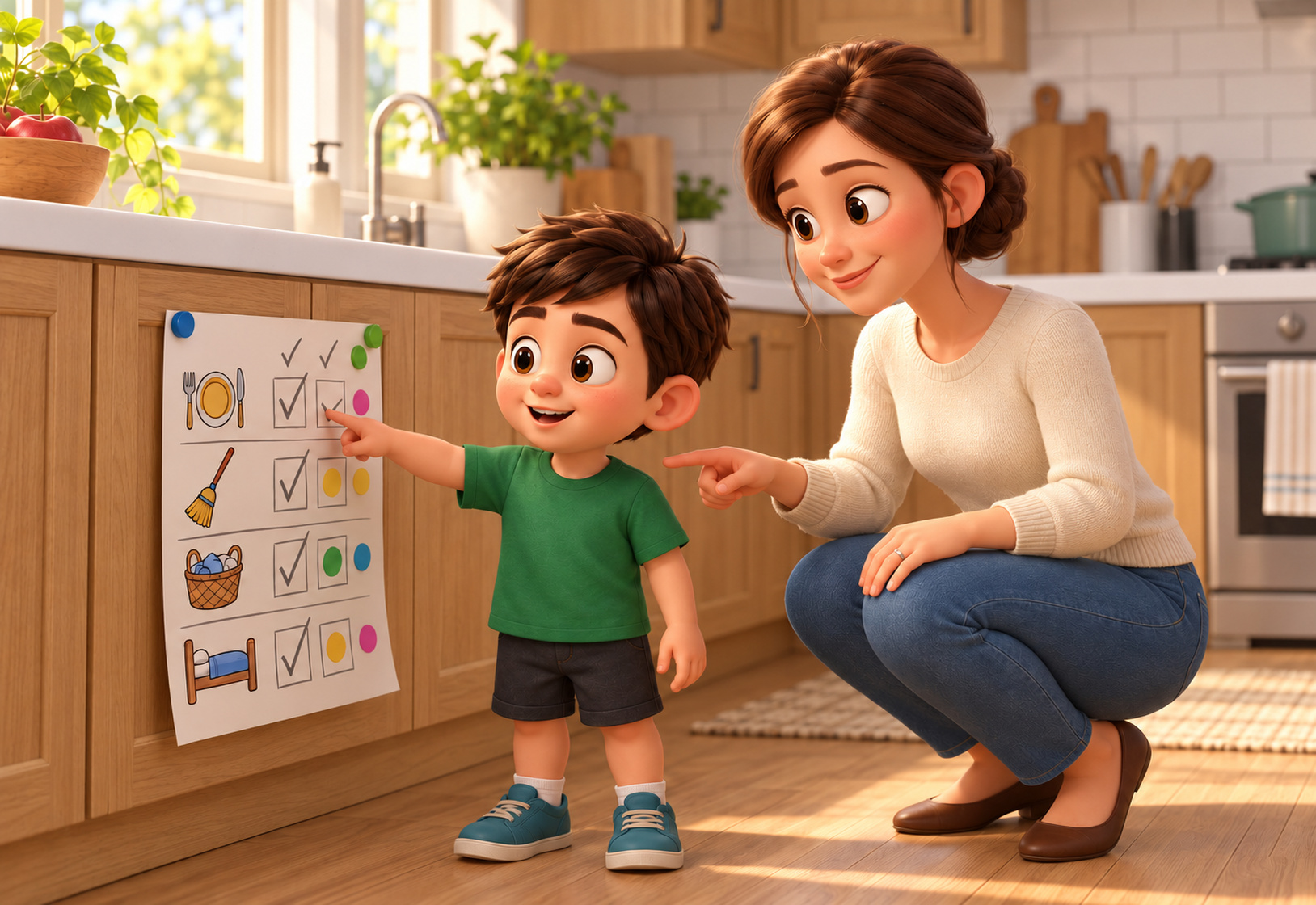
Visual Routine Charts for Kids Who Can’t Read Yet
Visual routine charts for kids are one of those parenting tools that sound almost too simple to work. A few pictures. An arrow pointing right. Maybe a checkbox. And yet, for children who are not reading yet, swapping written words for images can turn a chaotic morning into something that actually flows. If you have ever repeated “shoes, then backpack, then door” seventeen times before 8 a.m., you already know why this matters.
Why Pictures Work When Words Don’t
Young children, roughly ages 2-6, process images far faster than text. A cartoon of a toothbrush next to a smiling mouth tells a three-year-old everything they need to know. A note that says “brush teeth” tells them nothing, because those shapes on paper have no meaning yet.
There is also something about independence that clicks when a child can check the chart themselves. They are not waiting for you to remind them. They walk up, look at the picture, and go do the thing. That small shift, from parent-led to child-led, is bigger than it sounds. Kids who feel capable tend to cooperate more, simply because they are not being nagged.
Predictability matters too. When a child knows what comes next, transitions become less fraught. The chart is the authority, not you, and that takes a surprising amount of tension out of the room.
How to Build a Visual Routine Chart That Actually Gets Used
The ones that end up ignored are usually too complicated or too generic. Here is what tends to work instead:
- Use real photos when you can. A photo of your child’s actual shoes by your actual door is more meaningful than a stock illustration. It removes any guesswork.
- Keep it to 5-8 steps. More than that and the chart becomes overwhelming. If the routine genuinely has twelve steps, split it into a morning chart and a getting-out-the-door chart.
- Put it at their eye level. This sounds obvious, but a chart hung at adult height gets ignored. Mount it where little eyes naturally land.
- Add a simple completion signal. A velcro tick, a sliding button, or a checkbox they mark with a dry-erase marker. The act of marking it done is satisfying in its own right.
- Involve them in making it. Let your child help choose the pictures or stick them on. Ownership matters. They are far more likely to follow a chart they helped create.
Visual Routine Charts for Kids at Different Ages
Toddlers (Ages 2-3)
Keep it to three or four images, maximum. Nappy or potty, wash hands, sit for breakfast. Big bold pictures, no clutter. At this age the chart is more about narrating the routine than expecting independent follow-through, but that narration builds the habit.
Preschoolers (Ages 3-5)
This is the sweet spot for visual charts. Children this age love the ritual of checking off a task, and they are developing enough independence to move from one step to the next without hand-holding. Expand to 5-7 steps. Add a small reward at the end of the chart, even just a star sticker, to mark completion.
Early Primary (Ages 5-7)
At this stage, children are usually beginning to read, and you can start layering in simple words alongside pictures. The chart becomes a bridge between pure visual and written instruction. This is also when chores can get slightly more complex, and a tool like Tasks ‘n Chores becomes useful because it handles reminders, tracks completion, and ties tasks to rewards the child actually cares about.
When the Chart Stops Working
Most paper-based visual charts have a lifespan. The novelty fades, the laminate gets tatty, and suddenly the thing that used to work is wallpaper. This is not a failure of the idea. It is just what happens when families grow and routines change.
The answer is not to redraw the chart every month. It is to move toward something that updates easily, sends reminders automatically, and keeps the motivation alive with rewards that genuinely excite your child. Tasks ‘n Chores lets kids choose their own rewards, which turns out to be a significant factor in whether they actually try to earn them. A parent-chosen reward is fine. A reward the child picked themselves is motivating in a completely different way.
The goal of any routine chart, visual or otherwise, is to make the routine run without you having to be the reminder. Once your child is old enough to engage with a screen-based tool, Tasks ‘n Chores picks up exactly where the picture chart leaves off, without the faded laminate and the lost dry-erase marker.
When you’re ready to move beyond pictures on the fridge, take a look at how Tasks n Chores works.